
Cast Grinding Ball Microstructure: Why Snowflake Martensitic Structure Delivers Lower Wear Rates and Superior Impact Resistance
Views: 494 Update Date:Jun 15 , 2026
Introduction
 In the mining, cement, and mineral processing industries, the performance of cast grinding balls directly affects grinding efficiency, media consumption, and overall operating costs.
Many buyers focus only on hardness values such as HRC 58-65, believing that higher hardness automatically means longer service life. However, experienced metallurgical engineers know that hardness alone does not determine grinding ball performance.
The real difference lies in the microstructure.
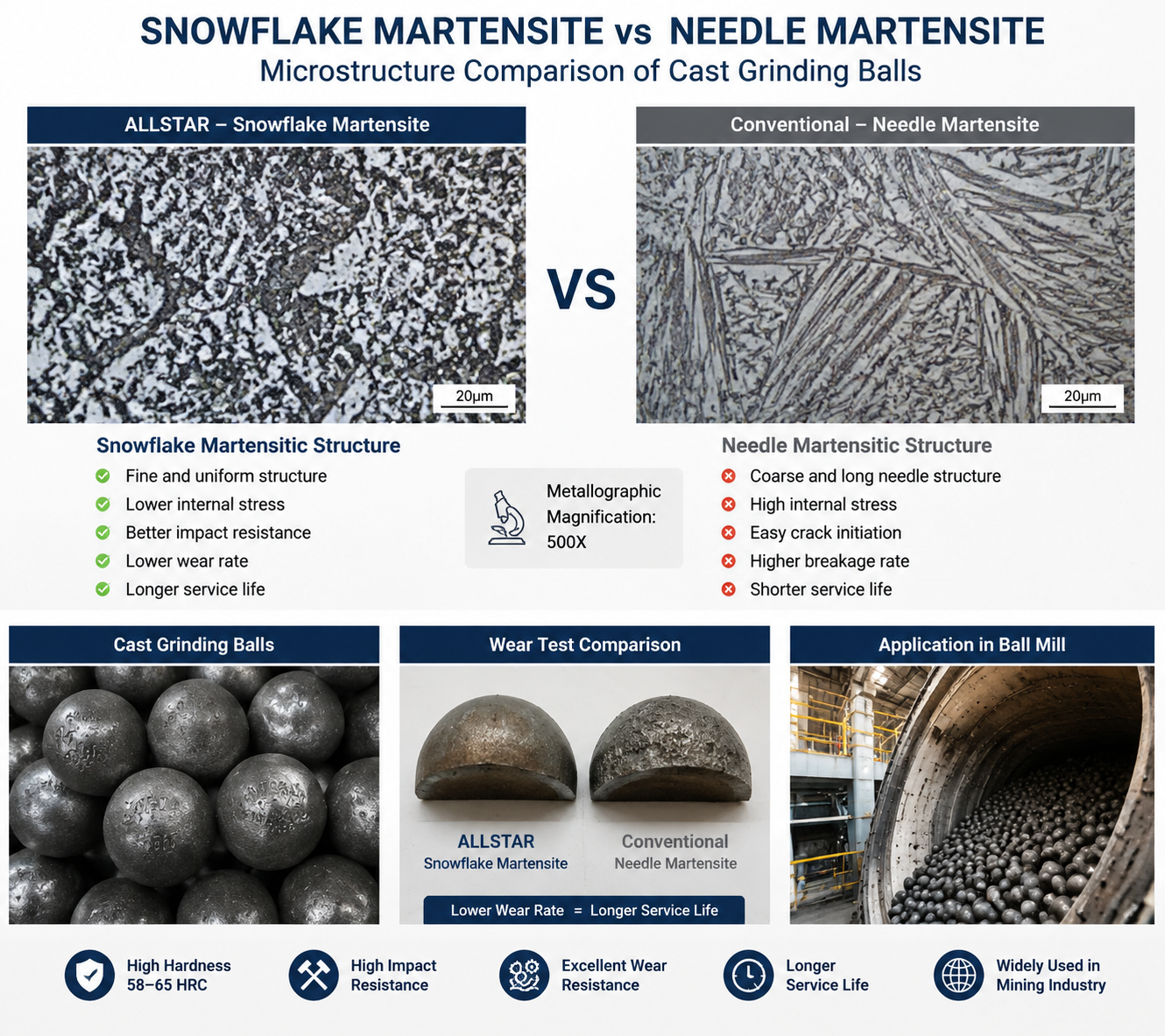
At ALLSTAR Grinding Ball, extensive research and heat treatment optimization have enabled us to produce cast grinding balls with a refined snowflake martensitic structure, significantly different from the needle-shaped martensite commonly found in lower-quality grinding media.
This article explains why microstructure matters, how snowflake martensite improves wear resistance, and why many mining companies are switching to premium microstructure-controlled grinding balls.
The most common microstructures found in cast grinding balls include:
- Martensite
- Bainite
- Pearlite
- Retained Austenite
- Carbides
Among these structures, martensite is generally considered the most desirable for high-performance grinding media because it provides:
- High hardness
- Excellent wear resistance
- Strong impact strength
- Long service life
However, not all martensite is created equal.
The morphology of martensite has a major influence on grinding ball performance.
Snowflake Martensite vs Needle Martensite
Many low-cost cast grinding balls develop coarse needle-shaped martensite during heat treatment.
While needle martensite can achieve high hardness values, it also creates several problems:
Problems of Needle Martensite
- High internal stress
- Increased brittleness
- Crack initiation points
- Higher breakage rates
- Reduced impact resistance
Under repeated impact inside a ball mill or SAG mill, these microcracks gradually propagate and eventually cause ball breakage.
This is why many grinding balls show acceptable hardness but still fail prematurely.
The benefits include:
1. Lower Internal Stress
Snowflake martensite distributes stress more evenly throughout the grinding ball.
Benefits:
- Reduced crack formation
- Improved structural stability
- Better resistance to cyclic impact
2. Improved Impact Toughness
Mining operations require grinding media capable of withstanding repeated impact.
Snowflake martensite provides:
- Higher toughness
- Better crack resistance
- Lower breakage rates
3. Superior Wear Resistance
Fine martensitic crystals increase the effective hardness of the grinding surface.
Result:
- Lower wear rate
- Longer service life
- Reduced grinding media consumption
4. Consistent Performance
Uniform microstructure means every grinding ball performs consistently.
This reduces:
- Size segregation
- Unexpected failures
- Media consumption fluctuations
Example:
Supplier A:
- Hardness: 62 HRC
Supplier B:
- Hardness: 60 HRC
Most buyers automatically choose Supplier A.
- Hardness
- Toughness
- Microstructure
- Carbide distribution
- Residual stress
Microstructure is often the hidden factor behind grinding media success.
Real Mining Challenges
Grinding balls operate under extremely severe conditions.
Applications include:
Gold Mining
Challenges:
- High impact
- Abrasive ore
Requirements:
- High toughness
- Low breakage
Copper Mining
Challenges:
- Continuous grinding
- Large throughput
Requirements:
- Stable wear resistance
Iron Ore Processing
Challenges:
- High hardness ore
Requirements:
- Excellent abrasion resistance
Cement Plants
Challenges:
- Long operation cycles
Requirements:
- Consistent grinding efficiency
ALLSTAR snowflake martensitic grinding balls are specifically engineered for these demanding environments.
Laboratory Verification
Every production batch undergoes:
Chemical Analysis
Ensures alloy consistency.
Hardness Testing
Target range:
58-65 HRC
Impact Testing
Verifies toughness.
Metallographic Examination
Confirms:
- Fine snowflake martensite
- Uniform carbide distribution
- Controlled retained austenite
Wear Rate Comparison
Typical field results show:
The lower wear rate translates directly into:
- Reduced grinding media consumption
- Lower replacement frequency
- Lower operating costs
What is the microstructure?
Can metallographic reports be provided?
What is the breakage rate?
What wear rate data is available?
Is the heat treatment process controlled?
These questions often reveal more than hardness numbers alone.
- Refined snowflake martensitic structure
- Lower wear rate
- Superior impact resistance
- Strict metallographic inspection
- Stable hardness 58-65 HRC
- Proven performance in mining applications
Our engineering team can also provide grinding media recommendations based on:
- Ore type
- Mill size
- Feed size
- Throughput requirements
While ordinary grinding balls often contain brittle needle-shaped martensite, ALLSTAR cast grinding balls utilize a refined snowflake martensitic structure that delivers:
- Lower wear rates
- Higher impact toughness
- Reduced breakage
- Longer service life
For mining companies seeking lower grinding costs and more reliable mill performance, microstructure should be a key selection criterion.
Contact ALLSTAR today for:
- Metallographic analysis
- Grinding media recommendations
- Wear rate evaluation
- Free sample support
Next: Forged vs Cast Grinding Ball: Complete Cost, Durability & Performance Analysis
In the mining, cement, and mineral processing industries, the performance of cast grinding balls directly affects grinding efficiency, media consumption, and overall operating costs.Many buyers focus only on hardness values such as HRC 58-65, believing that higher hardness automatically means longer service life. However, experienced metallurgical engineers know that hardness alone does not determine grinding ball performance.
The real difference lies in the microstructure.
At ALLSTAR Grinding Ball, extensive research and heat treatment optimization have enabled us to produce cast grinding balls with a refined snowflake martensitic structure, significantly different from the needle-shaped martensite commonly found in lower-quality grinding media.
This article explains why microstructure matters, how snowflake martensite improves wear resistance, and why many mining companies are switching to premium microstructure-controlled grinding balls.
What Is the Microstructure of a Cast Grinding Ball?
Microstructure refers to the internal arrangement of crystals and phases within steel after casting and heat treatment.The most common microstructures found in cast grinding balls include:
- Martensite
- Bainite
- Pearlite
- Retained Austenite
- Carbides
Among these structures, martensite is generally considered the most desirable for high-performance grinding media because it provides:
- High hardness
- Excellent wear resistance
- Strong impact strength
- Long service life
However, not all martensite is created equal.
The morphology of martensite has a major influence on grinding ball performance.
Snowflake Martensite vs Needle Martensite
Many low-cost cast grinding balls develop coarse needle-shaped martensite during heat treatment.
While needle martensite can achieve high hardness values, it also creates several problems:
Problems of Needle Martensite
- High internal stress
- Increased brittleness
- Crack initiation points
- Higher breakage rates
- Reduced impact resistance
Under repeated impact inside a ball mill or SAG mill, these microcracks gradually propagate and eventually cause ball breakage.
This is why many grinding balls show acceptable hardness but still fail prematurely.
The Advantages of ALLSTAR Snowflake Martensitic Structure
Through optimized alloy design, controlled cooling rates, and advanced heat treatment technology, ALLSTAR develops a fine and uniform snowflake martensitic structure.The benefits include:
1. Lower Internal Stress
Snowflake martensite distributes stress more evenly throughout the grinding ball.
Benefits:
- Reduced crack formation
- Improved structural stability
- Better resistance to cyclic impact
2. Improved Impact Toughness
Mining operations require grinding media capable of withstanding repeated impact.
Snowflake martensite provides:
- Higher toughness
- Better crack resistance
- Lower breakage rates
3. Superior Wear Resistance
Fine martensitic crystals increase the effective hardness of the grinding surface.
Result:
- Lower wear rate
- Longer service life
- Reduced grinding media consumption
4. Consistent Performance
Uniform microstructure means every grinding ball performs consistently.
This reduces:
- Size segregation
- Unexpected failures
- Media consumption fluctuations
Why Wear Rate Matters More Than Hardness
Many suppliers advertise only hardness.Example:
Supplier A:
- Hardness: 62 HRC
Supplier B:
- Hardness: 60 HRC
Most buyers automatically choose Supplier A.
However, if Supplier A contains coarse needle martensite and Supplier B contains refined snowflake martensite, Supplier B may actually deliver longer service life.
- Hardness
- Toughness
- Microstructure
- Carbide distribution
- Residual stress
Microstructure is often the hidden factor behind grinding media success.
Real Mining Challenges
Grinding balls operate under extremely severe conditions.
Applications include:
Gold Mining
Challenges:
- High impact
- Abrasive ore
Requirements:
- High toughness
- Low breakage
Copper Mining
Challenges:
- Continuous grinding
- Large throughput
Requirements:
- Stable wear resistance
Iron Ore Processing
Challenges:
- High hardness ore
Requirements:
- Excellent abrasion resistance
Cement Plants
Challenges:
- Long operation cycles
Requirements:
- Consistent grinding efficiency
ALLSTAR snowflake martensitic grinding balls are specifically engineered for these demanding environments.
Laboratory Verification
Every production batch undergoes:
Chemical Analysis
Ensures alloy consistency.
Hardness Testing
Target range:
58-65 HRC
Impact Testing
Verifies toughness.
Metallographic Examination
Confirms:
- Fine snowflake martensite
- Uniform carbide distribution
- Controlled retained austenite
Wear Rate Comparison
Typical field results show:
|
Microstructure Relative |
Wear Rate |
|
Needle Martensite |
High |
|
Mixed Structure |
Medium |
|
Snowflake Martensite |
Lowest |
The lower wear rate translates directly into:
- Reduced grinding media consumption
- Lower replacement frequency
- Lower operating costs
How to Select the Right Cast Grinding Ball
When evaluating grinding media suppliers, buyers should ask:What is the microstructure?
Can metallographic reports be provided?
What is the breakage rate?
What wear rate data is available?
Is the heat treatment process controlled?
These questions often reveal more than hardness numbers alone.
Why Choose ALLSTAR Cast Grinding Balls?
ALLSTAR advantages:- Refined snowflake martensitic structure
- Lower wear rate
- Superior impact resistance
- Strict metallographic inspection
- Stable hardness 58-65 HRC
- Proven performance in mining applications
Our engineering team can also provide grinding media recommendations based on:
- Ore type
- Mill size
- Feed size
- Throughput requirements
Conclusion
The true performance of a cast grinding ball depends not only on hardness but also on microstructure.While ordinary grinding balls often contain brittle needle-shaped martensite, ALLSTAR cast grinding balls utilize a refined snowflake martensitic structure that delivers:
- Lower wear rates
- Higher impact toughness
- Reduced breakage
- Longer service life
For mining companies seeking lower grinding costs and more reliable mill performance, microstructure should be a key selection criterion.
Request a Free Technical Consultation
Contact ALLSTAR today for:
- Metallographic analysis
- Grinding media recommendations
- Wear rate evaluation
- Free sample support


