
Forged grinding balls factory production steps from billet to ball
Shandong Allstar Grinding Ball Co., Ltd., known as ALLSTAR grinding balls, has specialized in grinding media since 1985. Originally state-owned and privately operated since 1999, it maintains rigorous management and strict quality control. The company operates 15,000 square metres of production facilities, employs 150 people, and has annual capacity of 100,000 metric tons. Its range includes forged grinding balls, cast grinding balls, high chrome grinding balls, grinding rods, and grinding cylpebs. The article explains forged grinding ball production from billet to ball. Raw round steel bars are sourced from large state-owned steel mills and tested for chemical composition. Billets are cut to length, heated under controlled conditions, and formed by air hammer forging or hot rolling. Heat treatment develops hardness and toughness. Inspection occurs throughout production, with batch sampling and testing after heat treatment. ALLSTAR maintains ISO 9001 and uses SGS, BV, and TUV verification. It has High and New Technology Enterprise and Specialized, Sophisticated, Distinctive and Innovative Enterprise recognition. Forged balls range from 20 to 150 mm. Applications include gold, copper, platinum, iron ore, nickel, phosphate, and lead-zinc mines, cement plants, and power stations. Larger media are used for coarse grinding and smaller media for fine grinding. Field results at Pinto Valley Mine showed stable consumption of 0.56 to 0.59 kg/t and 0.2 percent breakage, compared with 0.68 kg/t and close to 3 percent for another supplier. At Turkey YD Madencilik, combined grinding-ball consumption fell from 84.80 g/t in 2016 to 31.93 g/t in 2018 and 25.66 g/t in 2025. The article concludes that disciplined billet-to-ball production supports reliable quality, lower grinding costs, and stable mill operation.
Forged grinding balls are among the most important consumables in mining, cement, and power generation. The transformation from steel billet to finished ball involves a connected series of production steps, each of which influences wear life, breakage resistance, and mill stability. Shandong Allstar Grinding Ball Co., Ltd., known as ALLSTAR grinding balls, has specialized in manufacturing grinding media since 1985. Originally a state-owned enterprise, the company became privately operated in 1999 while continuing to uphold rigorous management standards and strict quality control practices. Integrity has remained a fundamental principle of its business operations.
ALLSTAR operates production facilities covering 15,000 square metres and employs 150 people, including experienced technical, production, and sales personnel. With annual grinding media production capacity of 100,000 metric tons, the company is equipped to meet requirements across different markets and project scales. Its product range includes forged grinding balls, cast grinding balls, high chrome grinding balls, grinding rods, and grinding cylpebs. Forged grinding balls are available in diameters from 20 mm to 150 mm and are manufactured through forging or hot-rolling processes. The factory production chain from billet to ball is designed to deliver consistent quality and dependable performance in SAG mills, ball mills, and rod mills.
undefined
Step 1: Raw Material Selection and Incoming Inspection
Quality control starts with raw materials. The round steel bars used for forged grinding balls and grinding rods are sourced from large state-owned steel mills in China. Upon arrival at the factory, incoming materials are sampled and tested for chemical composition to verify their quality. This step confirms that the steel grade is suitable for the intended ball size and application. For cast grinding balls, raw materials such as ferrochrome and iron scrap are proportioned and melted according to the required product grade. Chemical composition is analyzed after melting to ensure that the molten metal meets the specified requirements. For forged products, clean and consistent steel chemistry supports hardenability, toughness, and uniform response to heat treatment. A billet with unsuitable chemistry can lead to cracking, soft spots, or inconsistent wear in demanding grinding circuits.
Step 2: Billet Cutting and Controlled Heating
The round steel bar is cut to a length matched to the final ball diameter. Each billet is then heated in a furnace to the required forging temperature. Heating must be carefully controlled. If the steel is too cold, it resists deformation; if it is overheated, grain growth or surface decarburization can damage quality. The heated billet becomes plastic enough for shaping while retaining the metallurgical potential needed after heat treatment. This stage links raw material to forming and is monitored as part of batch traceability. Controlled heating helps the factory produce balls with sound internal structure and stable surface condition.
Step 3: Forging or Hot Rolling into Ball Shape
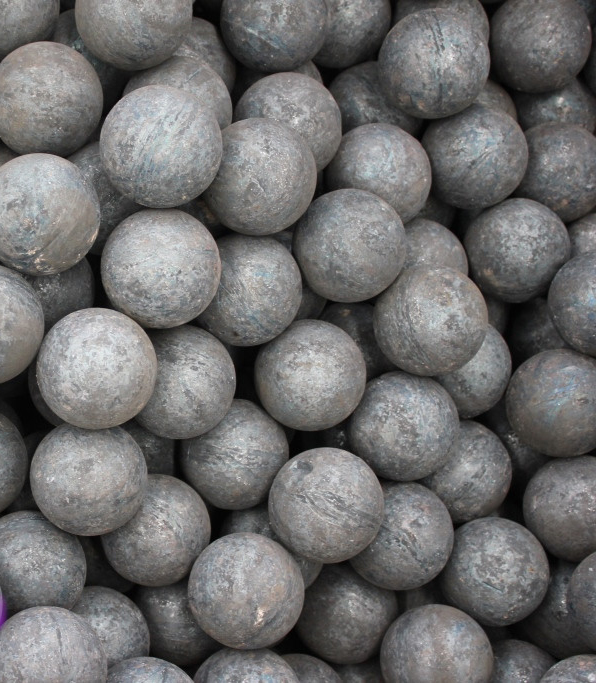
ALLSTAR operates both air hammer forged and hot-rolling production processes. In air hammer forging, the heated billet is shaped by controlled blows that form a round ball and refine the internal structure. In hot rolling, the billet passes through rolls that shape it into a ball with consistent dimensions. Both routes aim for dense structure, good sphericity, and controlled surface condition. The forming step determines much of the ball's dimensional accuracy and surface quality before heat treatment. Forged grinding balls are available in diameters from 20 mm to 150 mm, allowing the factory to supply different mill chambers and grinding duties. Larger balls are generally used for coarse grinding, while smaller balls support fine grinding in subsequent chambers.
Step 4: Heat Treatment for Hardness and Toughness
After forming, forged balls are heat treated. Quenching and tempering are used to develop the required balance of hardness and toughness. A ball that is too hard may crack under impact; a ball that is too soft may wear quickly. Heat treatment is therefore a critical control point in the billet-to-ball chain. Process parameters are managed by product size and grade, and finished products undergo further testing after heat treatment to check whether they meet the required quality and performance specifications. This disciplined approach helps ALLSTAR deliver grinding media that can withstand repeated impact and abrasion in industrial mills.
Step 5: Inspection, Testing, and Batch Traceability
Quality inspection is carried out throughout the manufacturing process. Samples are taken from each production batch for inspection. Tests check chemical composition, hardness, dimensions, surface condition, and other performance indicators. ALLSTAR maintains an ISO 9001 Quality Management System and supports product quality verification through professional testing and third-party inspection services, including SGS, BV, and TUV. The company has also been recognized as a High and New Technology Enterprise and as a Specialized, Sophisticated, Distinctive and Innovative Enterprise. These qualifications reflect technological capability, specialized manufacturing, and continuous innovation. Batch records help trace materials and process conditions from billet to finished ball, supporting consistency for customers worldwide.
Step 6: Packaging, Marking, and Delivery
Finished forged grinding balls are packed, marked, and prepared for shipment. Packaging protects surfaces and supports handling efficiency. Marking and batch identification help customers receive consistent products and maintain traceability at the plant. With annual grinding media production capacity of 100,000 metric tons, ALLSTAR is equipped to meet the requirements of clients across different markets and project scales. The company serves mining, cement, and power generation industries worldwide, and its business philosophy is to manufacture high-quality products, be a reliable supplier, and build long-term and sustainable partnerships.
Product Range and Application Selection
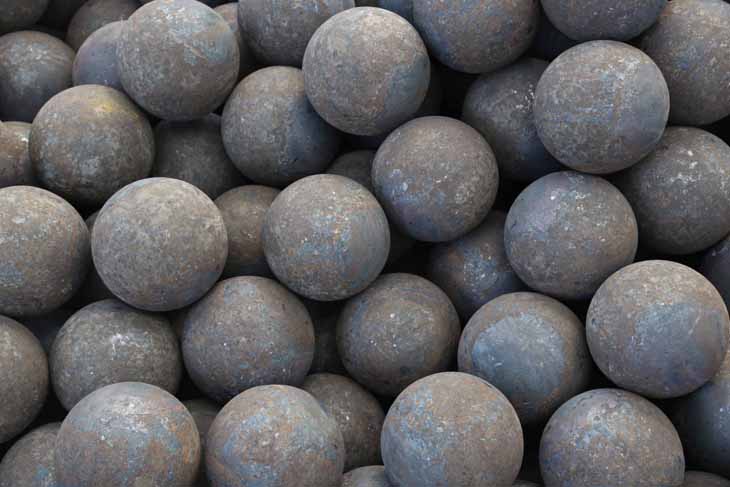
ALLSTAR offers different types and sizes of grinding media to meet various mill requirements. Forged grinding balls range from 20 mm to 150 mm. Cast grinding balls range from 6 mm to 150 mm, including different chromium-content grades for various grinding conditions. Grinding rods range from 25 mm to 140 mm in diameter and from 1,500 mm to 6,000 mm in length, mainly designed for rod mills. Applications include gold, copper, platinum, iron ore, nickel, phosphate, and lead-zinc mines, as well as cement plants and power stations. Larger grinding media are generally used in the first chamber of a mill for coarse grinding and breaking larger particles of ore or clinker. Smaller grinding media are commonly used in the second chamber for fine grinding. High chrome cast grinding balls are widely used in cement plants and power stations. In mining applications, forged grinding balls are commonly selected for wet grinding, while cast grinding balls are often used in dry grinding operations. The final selection should always consider the actual operating conditions.
Why the Billet-to-Ball Chain Matters
A forged grinding ball is only as reliable as the chain that produces it. Raw material chemistry, heating control, forming method, heat treatment, and inspection all influence wear rate, breakage, and mill stability. ALLSTAR combines manufacturing expertise, strict quality control, and practical application experience to deliver solutions that create measurable economic value. Different mills, ores, and operating conditions require different grinding media. Proper grinding media selection helps customers improve grinding performance, maintain stable mill operation, manage media consumption, and control overall grinding costs. ALLSTAR works with mining companies, mineral processing plants, cement manufacturers, power plants, and industrial distributors to understand their requirements and recommend suitable grinding media solutions.
Proven Performance in Mining and Cement
Field results show the value of consistent production. At Pinto Valley Mine in the USA, a nearly six-month comparative trial used ALLSTAR high-chrome grinding balls in one ball mill and another manufacturer's products in the other. ALLSTAR consumption remained stable at 0.56 to 0.59 kg per tonne of run-of-mine ore, with a breakage rate of only 0.2 percent. The other supplier's consumption reached 0.68 kg/t, with a breakage rate close to 3 percent. The mill using competitor products recorded more than 70 tonnes per hour lower output and over 5 percentage points lower grinding fineness. After the successful trial, the customer replaced the grinding balls in the second mill with ALLSTAR products. Daily processing capacity subsequently reached 53,000 tonnes, exceeding the designed capacity of 50,000 tonnes by 3,000 tonnes. To date, the mine has purchased and used more than 48,000 tonnes of ALLSTAR grinding media.
In the cement industry, Turkey YD Madencilik operated a combined roller press and ball mill grinding system. Grinding media consumption had historically been high due to difficult-to-grind materials such as slag and coarse fly ash. After replacing the grinding balls in both mills with ALLSTAR products in 2016, consumption decreased significantly. Combined grinding-ball consumption dropped from 84.80 g/t in 2016 to 31.93 g/t in 2018. More importantly, the reduction was sustained over the following years, reaching just 25.66 g/t in 2025, approximately 69.7 percent lower than the 2016 baseline. These real-world results demonstrate lower grinding media consumption, reduced breakage, improved grinding efficiency, more stable mill operation, and greater production capacity.
Conclusion
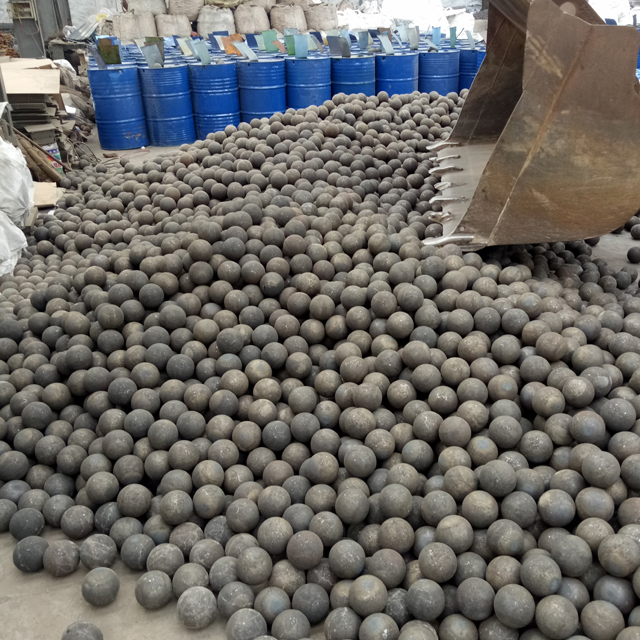
From billet selection to final inspection, forged grinding ball production requires disciplined process control. Each step protects the next: clean steel supports forming, controlled heating supports shaping, heat treatment develops hardness and toughness, and inspection confirms batch quality. For customers, the result is reliable grinding media that helps control costs and maintain stable mill operation. ALLSTAR grinding balls, operated by Shandong Allstar Grinding Ball Co., Ltd., continues to serve global industries as a long-term partner focused on proven performance, reliable quality, and greater value.


