
How a grinding rod factory controls straightness and length
This blog explains how a grinding rod factory controls straightness and length, using Shandong Allstar Grinding Ball Co., Ltd. as the example. Grinding rods are long steel bars used in rod mills to grind and crush ore, clinker and other materials. Their straightness affects mill charging, rod alignment, wear behaviour, breakage risk and liner loading, while their length affects fit, handling, charging practice and grinding stability. ALLSTAR manufactures grinding rods from 25 mm to 140 mm in diameter and from 1,500 mm to 6,000 mm in length, mainly for rod mills. The company has produced grinding media since 1985, was originally state-owned and became privately operated in 1999, and maintains strict quality control and integrity-based management. Control begins with incoming round steel bars from large state-owned steel mills, which are sampled and tested for chemical composition. Production planning considers diameter, length, steel grade, heat treatment and customer tolerances. Cutting is performed with controlled allowance, followed by deburring and end preparation. Straightening is carried out with suitable support and controlled force to avoid surface damage or new bending. Heat treatment is managed to balance hardness, toughness and dimensional stability. Inspection is multi-stage: incoming material, after cutting, after straightening, after heat treatment and before packing. Straightness can be checked with straightedges, feeler gauges, dial indicators, V-blocks or laser methods, while length is checked with calibrated measuring equipment after all dimensional operations. Nonconforming rods are segregated and corrected or rejected. Packing and handling are designed to prevent bending and surface damage during transport. ALLSTAR maintains ISO 9001 and supports third-party verification through SGS, BV and TÜV. The article concludes that straightness and length are process outputs controlled through raw material discipline, cutting planning, straightening, heat treatment, inspection and careful delivery, helping customers achieve stable rod mill operation and lower overall grinding costs.
Grinding rods are deceptively simple products. They are long steel bars used in rod mills to grind and crush ore, clinker and other materials, yet their performance depends on far more than chemical composition and hardness. In a modern grinding rod factory, straightness and length are two of the most important quality characteristics because they directly influence rod charging, mill operation, wear behaviour, breakage risk and the stability of the grinding circuit. Shandong Allstar Grinding Ball Co., Ltd., known as ALLSTAR grinding balls, has manufactured grinding media since 1985 and has developed practical controls for these two characteristics across raw material selection, cutting, straightening, heat treatment, inspection and delivery.
ALLSTAR was originally a state-owned enterprise and became a privately operated company in 1999. Since then, the company has continued to uphold rigorous management standards and strict quality control practices. Integrity has always been a fundamental principle of its business operations. This background matters in a product category such as grinding rods, where a supplier must combine industrial discipline with consistent process control. A rod that is slightly bent or cut to the wrong length may appear acceptable at the factory gate, but it can create handling difficulties, improper mill loading and uneven wear once it enters a rod mill.
The Product Context: Grinding Rods for Rod Mills
ALLSTAR specializes in manufacturing grinding media for SAG mills, ball mills and rod mills, serving the mining, cement and power generation industries. Its product range includes forged grinding balls, cast grinding balls, high chrome grinding balls and grinding rods. Grinding rods are available in diameters from 25 mm to 140 mm and lengths from 1,500 mm to 6,000 mm, mainly designed for rod mills. In mineral processing, rod mills are often selected for specific duties where a rolling, line-contact grinding action is preferred. The rod charge must remain aligned and stable, so straightness and length become part of the operating logic of the mill, not merely a cosmetic requirement.
undefined
The factory therefore treats straightness and length as process outputs that must be controlled from the first incoming steel bar to the final bundled rod. The company operates production facilities covering 15,000 square metres and employs 150 people, including experienced technical, production and sales personnel. With an annual grinding media production capacity of 100,000 metric tons, ALLSTAR is equipped to meet the requirements of clients across different markets and project scales. That scale makes standardized control procedures essential, because consistency cannot depend on individual operators alone.
Why Straightness Matters in a Grinding Rod
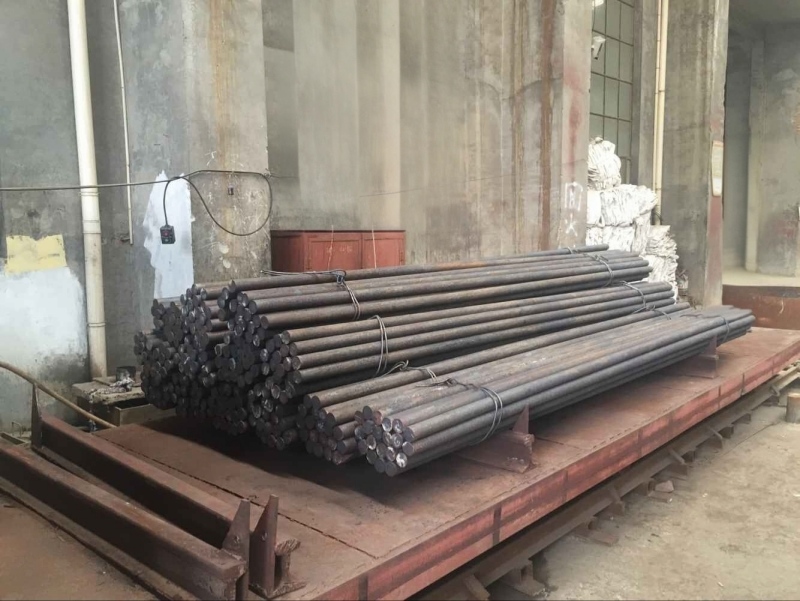
Straightness affects how rods sit in the mill and how they interact with one another. A bent rod can create point loading, abnormal contact and localised wear. In a rod mill, the rods are expected to roll and slide in a controlled manner. If a rod is out of straightness, it may disturb the charge profile, increase the risk of rod entanglement and cause uneven forces on the mill liners. Over time, these conditions can reduce grinding efficiency and increase maintenance attention.
Straightness also influences handling and safety. Long rods are stored, lifted, bundled and charged into the mill. A rod with excessive bow or bend can be difficult to guide, may jam in handling equipment and can create unnecessary mechanical stress during loading. For the customer, the practical value of straightness is therefore linked to stable operation, predictable rod consumption and reduced downtime risk.
At ALLSTAR, straightness control begins with a clear definition of what acceptable straightness means for each order. Because rods can range from 1,500 mm to 6,000 mm in length, the factory does not rely on a single visual impression. It uses measurable criteria, inspection methods and process adjustments that suit the diameter, length, steel grade and heat treatment route of the product. The goal is to deliver rods that are straight enough for reliable mill service and consistent enough for repeatable customer experience.
Why Length Matters in a Grinding Rod
Length is equally important. A grinding rod must fit the mill and the customer's charging practice. If a rod is too long, it may interfere with mill internals or create handling problems. If it is too short, it may not provide the intended grinding action and may affect the rod charge behaviour. Length also matters for wear allowance and for the way rods are bundled, transported and stored. In many cases, the customer specifies a nominal length with a permitted tolerance, and the factory must produce within that range consistently.
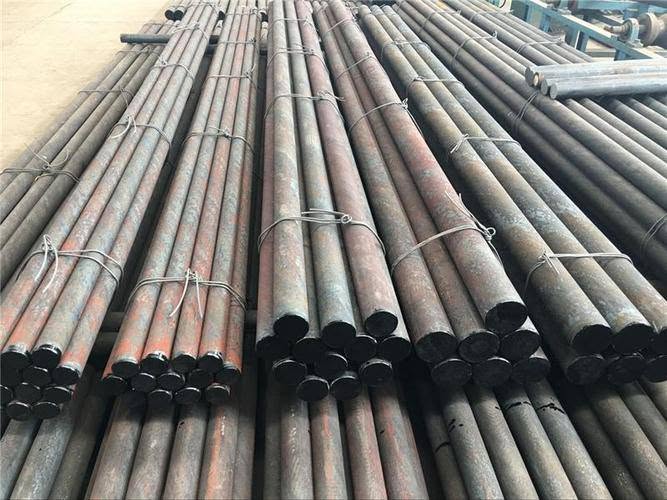
For ALLSTAR, length control is not simply a matter of cutting a bar to a number. The factory considers cutting allowance, heat treatment distortion, end finishing and final measurement. A rod that is cut to the correct final length before heat treatment may change slightly during processing, so the production route must account for these changes. This is especially important for long rods, where even a small percentage change can become a noticeable dimensional difference.
Raw Material Control Sets the Starting Point
Quality control starts with raw materials. The round steel bars used for forged grinding balls and grinding rods are sourced from large state-owned steel mills in China. Upon arrival at the factory, incoming materials are sampled and tested for chemical composition to verify their quality. For grinding rods, the incoming bar inspection also considers diameter, surface condition and general straightness, because a bar that arrives with severe bend or surface defects creates extra risk in downstream processing.
The factory records material information and maintains traceability so that a finished rod batch can be linked to its incoming steel source and inspection results. This is part of a broader quality approach that supports product quality verification through professional testing and third-party inspection services, including SGS, BV and TÜV. ALLSTAR maintains an ISO 9001 Quality Management System, which provides a structured framework for inspection, documentation and corrective action.
Production Planning for Straightness and Length
Before production begins, the factory reviews the customer's rod specification. This includes diameter, length, steel grade, hardness requirement, end finish and any special tolerances. The production team then plans the cutting length, straightening route and heat treatment conditions. For long rods, the plan must consider furnace loading, support during processing and the risk of sag or distortion. For smaller diameters, the plan must consider handling and the possibility of bending under their own weight if unsupported.
ALLSTAR works with mining companies, mineral processing plants, cement manufacturers, power plants and industrial distributors to understand their requirements and recommend suitable grinding media solutions. Different mills, ores and operating conditions require different grinding media. Proper selection helps customers improve grinding performance, maintain stable mill operation, manage media consumption and control overall grinding costs. In the case of grinding rods, the length and straightness requirements are discussed together with mill dimensions, charging practice and the expected wear life.
Cutting to Length with Controlled Allowance
The first major dimensional operation is cutting the steel bar to the required production length. The factory uses controlled cutting equipment and checks the cut length against the work order. For long rods, the cutting plan may include an allowance for heat treatment and end finishing. This allowance is not arbitrary; it is based on established process experience and is adjusted when the product specification requires a tighter final tolerance.
After cutting, the rod ends are inspected for squareness and surface condition. Poorly cut ends can affect handling, downstream straightening and final end finishing. The factory removes burrs and prepares the ends so that subsequent processing can proceed without introducing local bending or surface damage. Each batch is identified and tracked, and samples are taken from each production batch for inspection as part of the wider quality control system.
Straightening as a Controlled Process
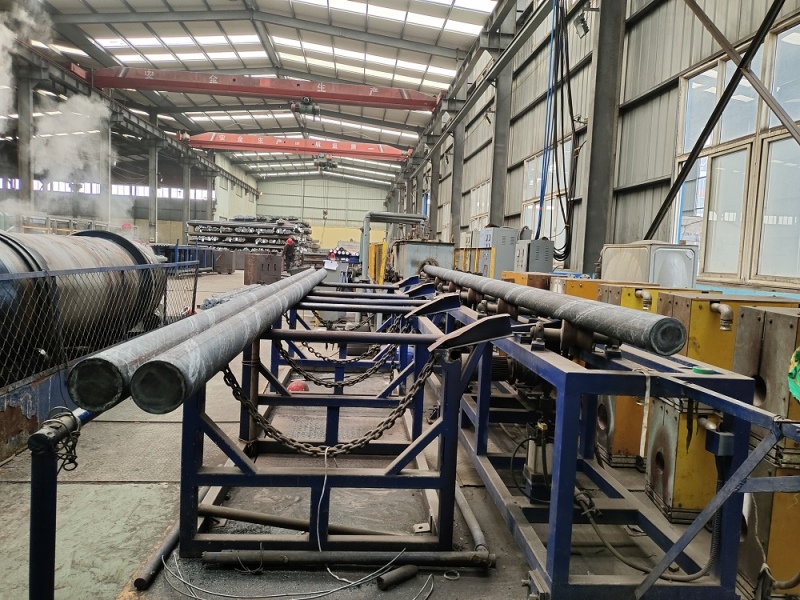
Straightening is one of the most important operations in grinding rod manufacturing. The factory may use mechanical straightening equipment, roller straightening principles or controlled press correction, depending on the rod size and condition. The objective is not to force the rod into a temporary shape but to reduce bend and residual curvature in a controlled manner. Excessive force can create surface marks, ovality or internal stress, so the operation must be applied with appropriate settings and operator skill.
For long rods, support is critical. The rod must be supported at suitable intervals during inspection and straightening so that its own weight does not create false readings or new bending. The factory pays attention to the condition of straightening rolls and contact surfaces to avoid gouging or scratching. After straightening, the rod is checked for straightness using established inspection methods before it moves to the next stage.
Where heat treatment is required, the factory also considers distortion during heating, quenching and tempering. Long products can distort if they are unsupported, heated unevenly or cooled too aggressively. Production planning therefore includes suitable loading patterns, furnace control and post-treatment verification. If correction is needed after heat treatment, it is performed under controlled conditions and followed by another straightness check.
Heat Treatment and Dimensional Stability
Heat treatment is essential for achieving the required mechanical properties, but it can also affect straightness and length. The factory controls furnace temperature, heating rate, holding time and cooling conditions to support consistent product quality. For grinding rods, the balance between hardness, toughness and dimensional stability is important. A rod that is hard but bent is not a reliable product; a rod that is straight but lacks the required wear resistance is also not suitable.
After heat treatment, finished products undergo further testing to check whether they meet the required quality and performance specifications. This includes dimensional checks for length and straightness, as well as hardness and other quality characteristics. Samples are taken from each production batch, and inspection records are maintained. The factory aims to deliver consistent and reliable grinding media to customers worldwide.
Inspection Methods for Straightness
Straightness inspection can be performed using several practical methods. A straightedge and feeler gauge can be used to assess local bow over a defined length. A dial indicator on supported V-blocks can measure runout or deviation along the rod. For longer rods, laser-based measurement or other non-contact methods may be used where appropriate. The factory selects the method according to the product size, specification and inspection stage.
The key is consistency. Inspection results are recorded against the batch and compared with the agreed acceptance criteria. If a rod exceeds the permitted deviation, it is segregated for further evaluation, correction or rejection. The factory does not rely on a single final check; straightness is monitored at incoming material, after cutting, after straightening, after heat treatment and before packing. This multi-stage approach reduces the chance of a nonconforming rod reaching the customer.
Inspection Methods for Length
Length inspection is straightforward in principle but must be disciplined in practice. The factory checks cut length and final length using calibrated measuring equipment. For long rods, proper support and alignment are necessary to obtain a reliable reading. The measurement is compared with the customer specification and the internal control limit. Where the customer requires a specific tolerance, the factory records the result and confirms that the batch is within the agreed range.
End finishing also affects the final length and appearance. The factory controls chamfering, deburring and end preparation so that the rod is safe to handle and suitable for the mill. Final length verification is performed after all dimensional operations are complete. The combination of cutting control, heat treatment planning, end finishing and final inspection provides a practical system for maintaining length consistency across large production batches.
Process Discipline and Traceability
ALLSTAR operates both air hammer forged and hot-rolling production processes for forged products and uses advanced coated-sand shell molding and automated production lines for cast products. For grinding rods, the relevant manufacturing route is supported by strict process discipline. Each batch carries identification, and inspection results are linked to production records. This traceability supports customer confidence and allows the factory to investigate any issue with a clear factual basis.
The company has been recognized as a High and New Technology Enterprise for its technological capabilities, research and development activities and innovation achievements. It has also been recognized as a Specialized, Sophisticated, Distinctive and Innovative Enterprise for its specialized expertise, advanced manufacturing capabilities, distinctive products and innovation-driven development. These recognitions reflect a broader commitment to technological advancement and continuous innovation, which also supports the practical control of product dimensions.
Packing, Handling and Delivery
Straightness and length control do not end at the inspection table. Long grinding rods must be packed and handled in a way that prevents bending, surface damage and corrosion during storage and transport. The factory bundles rods with suitable support and lifting arrangements so that the bundle remains stable. Packaging is designed to protect the rod ends and surfaces, and the loading plan considers the length and weight of the product.
For the customer, good packing means that the rods arrive in the same condition as they left the factory. This is particularly important for long rods, where poor handling can introduce bend that was not present at final inspection. ALLSTAR aims to be a reliable supplier and to build long-term and sustainable partnerships with its clients. Rather than focusing solely on individual transactions, the company is committed to creating long-term value through reliable products and responsible business relationships.
Customer Value and Application Experience
Different mills, ores and operating conditions require different grinding media. Proper grinding media selection helps customers improve grinding performance, maintain stable mill operation, manage media consumption and control overall grinding costs. ALLSTAR works with mining companies, mineral processing plants, cement manufacturers, power plants and industrial distributors to understand their requirements and recommend suitable grinding media solutions. In rod mill applications, the factory discusses rod diameter, rod length, mill dimensions, ore characteristics and charging practice so that the delivered product fits the application.
The company's business philosophy is simple: to manufacture high-quality products, be a reliable supplier and build long-term and sustainable partnerships with clients. In grinding rods, this philosophy is expressed through measurable controls. Straightness is controlled through incoming inspection, supported handling, controlled straightening, heat treatment discipline and multi-stage verification. Length is controlled through production planning, cutting allowance, end finishing and final measurement. These controls may not be visible in a sales brochure, but they are visible in the way the rods perform in the mill and in the confidence customers place in repeat orders.
Conclusion
A grinding rod factory controls straightness and length by treating them as core manufacturing variables rather than final inspection details. Shandong Allstar Grinding Ball Co., Ltd. combines raw material control, production planning, cutting, straightening, heat treatment, inspection and careful packing to deliver grinding rods for rod mills in the mining, cement and power generation industries. Its grinding rods are available in diameters from 25 mm to 140 mm and lengths from 1,500 mm to 6,000 mm, and each order is approached with attention to the customer's mill conditions and operating requirements. With manufacturing experience since 1985, a 15,000 square metre production base, 150 employees and an annual capacity of 100,000 metric tons, ALLSTAR continues to support global industries with proven performance, reliable quality and greater value.


